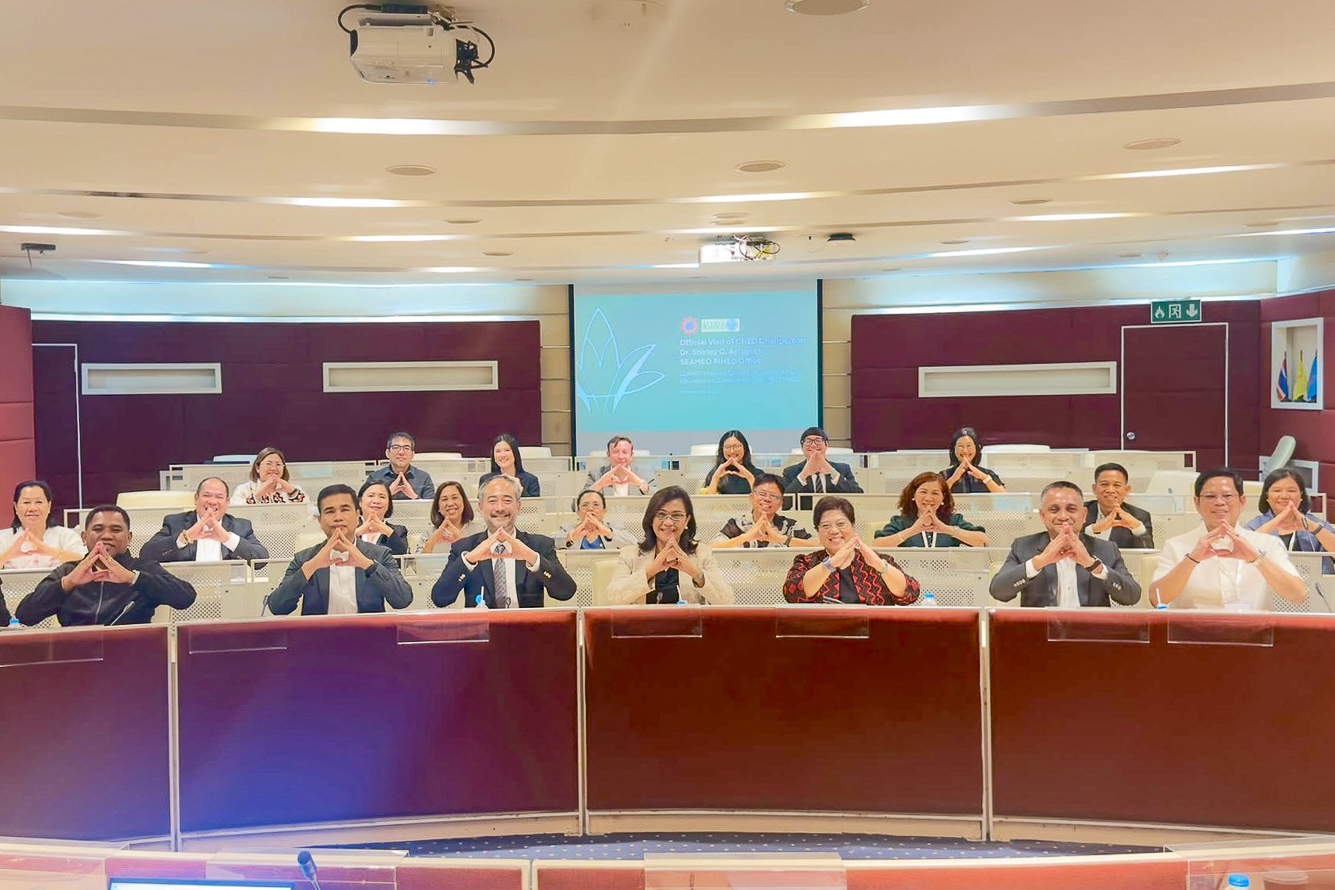
Tarlac State University President Dr. Jasper Jay N. Mendoza joined Commission on Higher Education (CHED) Chairperson Dr. Shirley C. Agrupis in her official visit to the SEAMEO Regional Centre Specializing in Higher Education and Development (SEAMEO RIHED) on November 20, 2026, in Bangkok, Thailand.
Pres. Mendoza was part of the Philippine delegation together with Dr. Jennie V. Jocson, Executive Director of the Teacher Education Council (TEC) Secretariat, and fellow presidents of state universities and colleges (SUCs), meeting with SEAMEO RIHED Centre Director Dr. Choltis Dhirathiti to discuss how to carry out regional initiatives that will shape higher education across Southeast Asia.
The session addressed three regional measures that ASEAN higher education ministers adopted on June 26, 2026, at a ministers’ roundtable hosted by the Philippines through CHED under its ASEAN chairship. According to CHED, the Bangkok meeting follows its request for regional support at SEAMEO RIHED’s 34th Governing Board Meeting in Iloilo City on 13–14 October 2026.
The first measure discussed is the ASEAN Ministerial Statement on Access to Quality Higher Education through Digital Transformation and Sustainability. It lays out a shared regional direction for widening access to higher education, including through AI-enabled learning.
The second is the Terms of Reference of the ASEAN Center for Teacher Education and Development (ACTED). The document outlines how the proposed regional center for teacher development will be established and operated. It will also be on the agenda for the SEAMEO meeting in March 2027.
The agenda speaks directly to teacher education, the field where Pres. Mendoza built his career. He rose through the College of Education, where he served as dean from 2019 to 2025, and was a technical writer for the TEC’s Reframed Teacher Education Curriculum. The ACTED discussion places that national reform work within a regional setting.
The third measure is the ASEAN GEMS Plus Project Proposal. It widens the existing ASEAN Global Exchange for Mobility and Scholarship (GEMS) platform beyond scholarships and student exchange to cover research grants, researcher mobility, and innovation partnerships.
As the chairperson of the Development Council of State Universities and Colleges – Region III (DC–SUC III), which represents thirteen SUCs in Central Luzon, Pres. Mendoza said the ASEAN GEMS Plus opens up opportunities for their faculty and students to participate in regional scholarships, research grants, and researcher exchanges.
CHED has said the three measures will guide regional cooperation under the ASEAN Work Plan on Education 2026–2030.
The SEAMEO RIHED officials encouraged the SUC presidents to take up two opportunities. The SUC presidents were encouraged to apply as accreditors under the ASEAN University Network – Quality Assurance (AUN-QA). The SUCs were also invited to the EU-ASEAN Thematic Research Sessions and Matchmaking on Space Cooperation and Disaster Management, with the first online session scheduled for December 16, 2026.
The 90-minute session will feature three ASEAN and three European research speakers. It covers earth observation, land fires, transboundary haze, environmental monitoring, disaster preparedness, and Copernicus data. It also opens opportunities under the Marie Skłodowska-Curie Actions (MSCA) Doctoral Networks and Staff Exchanges and is open to all universities across Southeast Asia.
The visit advances TSU’s DALAN Framework and its RISE FORWARD strategic directions, approved by the Board of Regents. It serves four of the eleven pathways most directly: Engagement and Global Partnerships, through ASEAN GEMS Plus; Accreditation, Quality Assurance, and Global Standards, through AUN-QA; Research and Innovation for Sustainable Development, through the EU-ASEAN research sessions; and Future-Ready Curricula and Instruction, through ACTED.